-
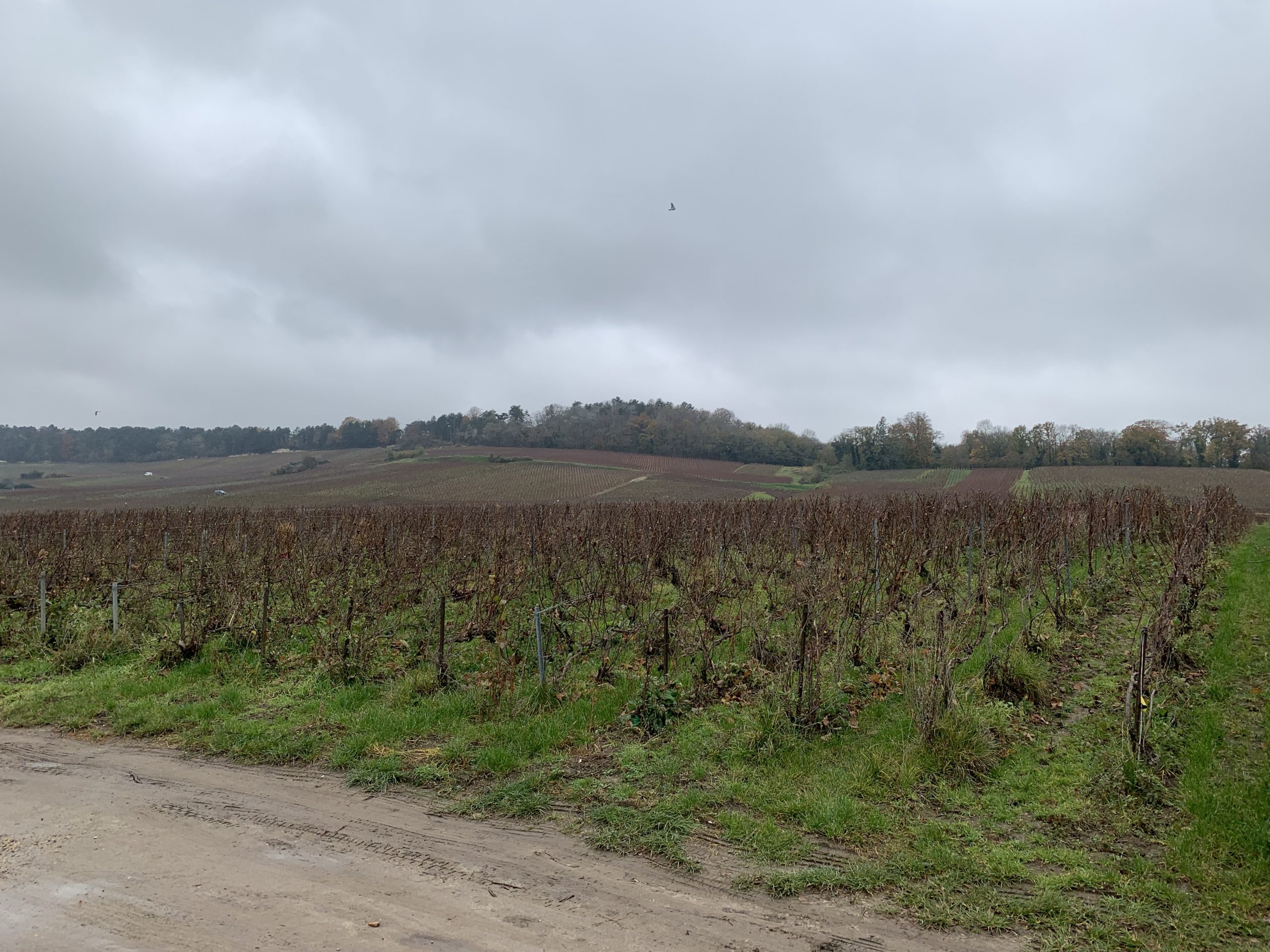
We had the chance to take a short trip to France in November of 2021, specifically in the Champagne region. We spend a long weekend visiting family (who make Champagne Fresne Ducret), and took one day to visit some champagne producers. We’d been to the area a few times, but hadn’t tried any champagne other than Fresne Ducret (which is obviously our favourite). First thing on the itinerary was a Covid test, as it was required for re-entry to Canada. Then we headed north to Champagne Miniere F&R.
Champagne Miniere F&R
As we wound our way through the narrow streets of Hermonville, Google Maps told us we had arrived. We spotted a small sign indicating that this was indeed Champagne Miniere F&R. We squeezed through the entrance up the hill to a lovely modern building behind the house, and announced our presence by setting off the car alarm. We were met by Fredric Miniere, the co-owner and winemaker. Frederic was very welcoming and friendly, and generously spoke English for most of our visit. He’d occasionally switch to French to better get an idea across, or find the right word, and Lindsay would attempt to translate.
We started the tour with a bit of the history; the vineyards have been in Frederic and his brother Rudolf’s family for generations, dating back to their great-grandfather. Prior to them taking over, their family mostly sold grapes, and made some wines through the local cooperative, selling them in the surrounding areas. The brothers decided to make their own champagne, and were heavily influenced by Anselme Solosse, a significant force in the prior generation of independent producers.
As Frederic talked, we walked through a loading dock area that contained pallets of champagne that were ready for disgorging, then into the main area of the winery. This housed some tanks for blending, and a large area filled with oak barrels. Miniere does all of their fermentation in barrels, and uses a wide variety of ages and coopers; some are from the only remaining cooper in Champagne, who is also in the village of Hermonville.

After seeing the barrels and explaining the process, we were shown the pressing room, and discussed the 2021 vintage. This was a very challenging year for Champagne, due to frost and other factors, and Miniere had yields that were about half of a normal year. As a result, they sold fewer grapes than they normally do, keeping them for their own production. Frederic expressed confidence would be a good year despite the lower yields, and that “there are no bad years, only bad winemakers”. Most of their grapes come from the Hermonville slopes right behind the winery, and others are scattered around the surrounding area. Most of the soil here is sand, with some limestone, silica, and clay. In fact, they have some old vines in sandy soil that are ungrafted (planted as far back as 1962), as the sandy soil has protected them the spread of phylloxera.
Tasting from the Barrels
After the initial overview, Frederic took us back to the barrels to taste. As he said, “now we’ll taste from the barrels”, and stepped away grab a wine thief and glasses, I looked at Lindsay like I’d just won the lottery. We’ve had some lovely wine tastings, but tasting direct from the barrel was something I’d only read about in books, and I could barely believe our luck. We first tasted a barrel of Pinot Munier; the high acidity of the base wine was balanced by a lovely fruitiness, aromas of red apple just bursting out of the glass. I was surprised when he took us to another barrel, then another and another; five different barrels in all. It was wonderful to see what Pinot Noir brought in a Pinot Noir-Pinot Munier blend, and then to experience the complexity of the old, ungrafted Pinot Munier vines. The Chardonnay was also lovely, and tasting the difference between a 1 year old and 10 year old barrel was educational; the oak aromas on the first added so much, but I could see how it needed to be tempered by other neutral barrels. Miniere generally avoids malolactic fermentation (he talked about bringing the barrels outside in the winter?), but did show us a couple barrels where it was occurring, and you could hear the fermentation bubbling.

The Champagnes
Next we went to the small tasting room, and he brought out the finished product. Two interesting views he expressed that were new thoughts to me. First, that straight from the fridge was too cold for his champagne, it gave more of the flavours at a slightly warmer temperature. I’ve often enjoyed the second half of a glass better than the first, so that made sense to me. The second was that his champagne was better and more expressive the next day after opening, and I’ll do my best to test this out.
We started with the Absolu Blanc de Blanc, with most of the wines from the 2016 vintage. This was my favourite of the tasting—there was a brioche, lemon curd, leesy, almost a cheese note on the nose. I would have been happy to just sniff this all day. Alas, there was more to taste, and it was well worth it. We moved on to the Influence, their main cuvee, also mostly from 2016 wines. This was a traditional assemblage, with Pinot Munier, Pinot Noir, and Chardonnay. There was a lovely richness, balance, and a spine of acidity that held it taut and upright. Both of these wines spent at least 60 months on the lees before disgorgement, and the complexity and autolytic characteristics were evident.
Next was the 2017 Influence Rose. This Rose d’assemblage has about 5% still Pinot Noir added, and the Pinot Noir character really shone through. This was light, balanced, subtly fruity, and Lindsay rates this as her absolute favourite rose.

Once again I was surprised when the tasting continued. After going through the 3 he’d brought out initially, he proceeded to get 2 more that he’d just disgorged the day before. He’d opened them up in order to assess how the elements of the blend were coming together, so as to inform his upcoming blending of the 2021 wines. These had no dosage, and without even that minor bit of balancing sweetness (they usually only dose ~3g/l), the searing acidity is what really shone. These were also lovely wines, and it was interesting to compare them.
We had limited room in our suitcases for bringing back wine, but after the 2 hours we spend together learning about and tasting these delicious champagnes, we felt compelled to buy 2 each of the ones we’d tasted. Frederic was initially hesitant, as he didn’t have bottles labeled, but when pressed he agreed.
Off to Épernay, then back to Ville Dommange
Next on our agenda was the Chateau Comtesse Lafond, in Épernay. We had some time before our tour, so we stopped for a baguette and pastry, and ate while we walked the Avenue de Champagne. It was astounding to see all these famous big champagne houses, all in a row. Pol Roger, Moët & Chandon, Perrier-Jouët, Mercier, and more.

Chateau Comtesse Lafond is one of the last houses as you head out of the city centre, and it’s in an old mansion that has been delightfully restored. The tour was lovely, and the champagne was pleasant.

Next we were back to Ville Dommange for a quick visit to F. Bergeronneau-Marion. The champagne’s here were nice, and it was interesting to see what another small producer was like.
Then it was back to our generous hosts, where we tasted an exquisite Fresne Ducret Pierre & Prosper, which is their top cuvee. Barrel aging, and 60 months on the lees resulted in astounding complexity and subtlety. An unexpected and wonderful final touch to an amazing day in Champagne!
-
Our plan this summer had been to sail from Burlington to Niagara, bring our bikes, and visit some wineries. The pandemic has made things like that a bit more complicated, but we still wanted to taste some wine, so we just drove to the Twenty Valley on a Sunday afternoon.
Back 10 Cellars and Malivoire Wine Company were a couple of wineries that had been on our list, but missed, on a previous trip. They both currently offer tasting flights, and didn’t need reservations, so away we went.
Back 10 Cellars
I’d read a bit about Back 10’s interesting story, and we’d had their Riesling during our Riesling tasting, so I was looking forward to the visit. They had a great setup outside, a small check-in area where they collected information for COVID tracking, then out to their large covered pergola area with picnic tables for the tasting.
We shared a flight that consisted of their Smitten Sparkling Riesling, The Big Reach Riesling, Start from Scratch Chardonnay, Everything at Stake Gamay, and The Big Leap Cabernet Franc. Andrew Brooks, one of the owners, came out and was chatting with the guests. He was generous with his time and we had a lovely chat about topics ranging from Niagara Gamay vs Cru Beaujolais, to how their winery has been affected by COVID, to what it is like raising teenagers who are stuck at home.
The Whites
The Sparkling Riesling was nice, but there is something about Charmat-method sparkling (like Prosecco) that I’m not a fan of. I loved the still Riesling; it was on the lighter side, well-balanced acidity, nice fruit notes, and compared favourably to a nice German Riesling we’d recently had. The Chardonnay was very good; a bit of acidity and fruit, interesting notes from the Canadian oak used for aging, a lingering finish that unfolded with notes of brown sugar, caramel, butter, and “Jelly Belly Buttered Popcorn” for Lindsay.
The Reds
The Gamay was the only one of the wines we tasted whose fruit didn’t come from the Back 10 vineyards, as they purchase their Gamay from a nearby grower towards the Lake Ontario. This was a very fruity style, with a light amount of aging in oak that added a bit of complexity. Overall a great summer wine, almost like a deeper, stronger rosé.
For the Cabernet Franc, I’ll admit that I haven’t had one that I’ve especially enjoyed. I’ve found the green pepper notes that are sometimes present in Niagara Cab Franc’s off-putting, but I didn’t mind this one. It had nice fruit notes, and the green pepper was subtle.
We bought a bottle of the Riesling, Chardonnay, and Gamay, as well as a copy of their book – To Build a Vineyard. I really enjoyed the book; if the idea of starting a vineyard from scratch interests you, I’d recommend it.
Malivoire Wine Company
We’d been fans of Malivoire’s Ladybug Rosé for a long time; after coming back from our first trip to Europe and trying to find rosé in the LCBO, it was nicely dry, and full of flavor. We also love their Gamay, and I was really intrigued listening to Martin Malivoire on the Between the Vines podcast, talking about the trip he and his staff took to Beaujolais. It was a fascinating listen, especially hearing him talking about what they learned tasting the Cru Beaujolais compared to their Gamay.
The Wines
At Malivoire we went from dry to sweet; Estate Grown Chardonnay, Moira Rosé, Small Lot Gamay, Che Bello sparkling.
The Moira Rosé was delicious; light, fruity, complex, refreshing. At the time of the tasting it seemed to be maybe the best rosé I’ve had.
The Chardonnay was also a delight; only half of the grapes undergo malolactic fermentation, so it had nice acidity, with a some softness on the finish. Lingering notes of creamy vanilla after fresh fruit on the palate, along with some minerality. Such a nice example of Chardonnay.
The Small Lot Gamay is even nicer than their regular version that you get in the LCBO. More notes of forest floor after the fruit, lots of complexity.
As mentioned for the Smitten from Back 10, prosecco-style sparkling isn’t my cup of tea, but this was nice.
I can’t wait to come back to Malivoire. Would love to do a tasting of all their Gamay’s, and try their Pinot Noir, Gewürztraminer, and Melon (currently sold-out).
